Difference between revisions of "Proof-of-X"
From IridiaWiki
Jump to navigationJump to search| Line 21: | Line 21: | ||
* Consider longest chain (the one with the most work in it) as the true chain |
* Consider longest chain (the one with the most work in it) as the true chain |
||
* To find UTXOs: |
* To find UTXOs: |
||
| − | ** (optional) Build Bloom filter for the desired transaction (a Bloom filter allows for testing set membership; it can have false positives but no false negatives) |
+ | ** (optional) Light Client: Build Bloom filter for the desired transaction (a Bloom filter allows for testing set membership; it can have false positives but no false negatives) |
| − | ** Send request to a full node: "Please give me all partial Merkle branches that match the Bloom filter for the given block" |
+ | ** Light client: Send request to a full node: "Please give me all partial Merkle branches that match the Bloom filter for the given block" |
| − | ** Full node |
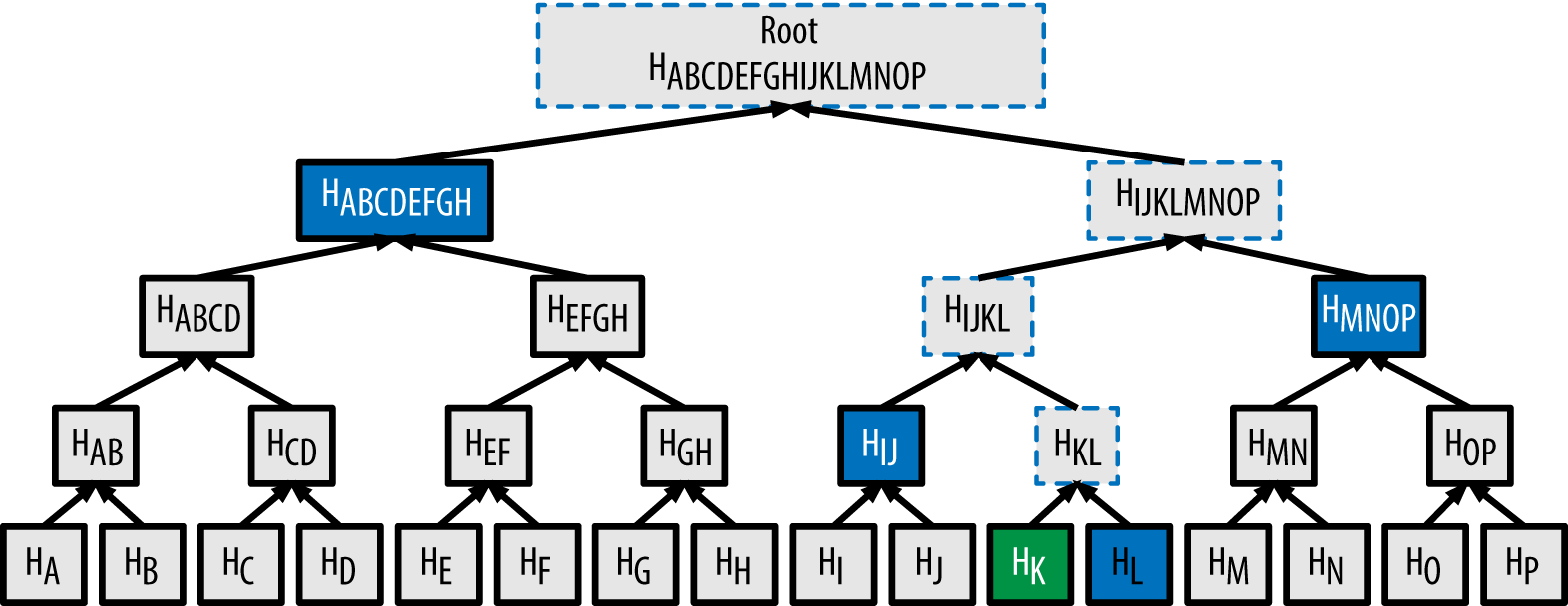
+ | ** Full node: Send the matching transactions and the other needed hashes from the Merkle tree to the light client (see, e.g., [http://orm-chimera-prod.s3.amazonaws.com/1234000001802/images/msbt_0705.png Merkle tree]) |
| + | ** Light client: Calculate hash for the transaction, combine with other needed hashes until the Merkle root is reached, check that the Merkle root matches the one from the previously downloaded block headers |
||
| ⚫ | |||
| + | ** The link from the transaction to the Merkle root shows that a transaction is indeed contained in a block; the requested block is linked to the rest of the blockchain via the PoW; the combination of both links proves that the transaction is recorded in the blockchain (received data: about 1KB instead of 1MB for a entire block) |
||
| + | |||
| + | Problems: |
||
| ⚫ | |||
| + | * Full nodes can fool light clients and can say that a transaction is not included in a block (but they can not say that a transaction is included in a block when in fact it is not) |
||
== Advantages == |
== Advantages == |
||
Revision as of 23:17, 21 November 2016
General
Goal: Secure updating of a state
Block time: trade off between time
Proof of Work
- Right to create new block: be the first to solve a puzzle based on consumption of a resource external to the system
- Miners choose one of all possible forks to contribute to (or splits among chains but with reduced efficiency per chain)
Light Clients
Algorithm:
- Download block headers from peers, consisting of
- Merkle root
- Hash value from previous block
- Nonce
- Verify proof-of-work for each block header: hash(Merkle root, previous hash, nonce) < target (based on difficulty)
- Consider longest chain (the one with the most work in it) as the true chain
- To find UTXOs:
- (optional) Light Client: Build Bloom filter for the desired transaction (a Bloom filter allows for testing set membership; it can have false positives but no false negatives)
- Light client: Send request to a full node: "Please give me all partial Merkle branches that match the Bloom filter for the given block"
- Full node: Send the matching transactions and the other needed hashes from the Merkle tree to the light client (see, e.g., Merkle tree)
- Light client: Calculate hash for the transaction, combine with other needed hashes until the Merkle root is reached, check that the Merkle root matches the one from the previously downloaded block headers
- The link from the transaction to the Merkle root shows that a transaction is indeed contained in a block; the requested block is linked to the rest of the blockchain via the PoW; the combination of both links proves that the transaction is recorded in the blockchain (received data: about 1KB instead of 1MB for a entire block)
Problems:
- Depends on the willingness of full nodes to provide the requested information and they don't have an incentive for doing so
- Full nodes can fool light clients and can say that a transaction is not included in a block (but they can not say that a transaction is included in a block when in fact it is not)
Advantages
Disadvantages
Proof of Stake
Light Clients
Advantages
Disadvantages
- Nothing at stake: Miners (voters) can vote on all forks of a blockchain